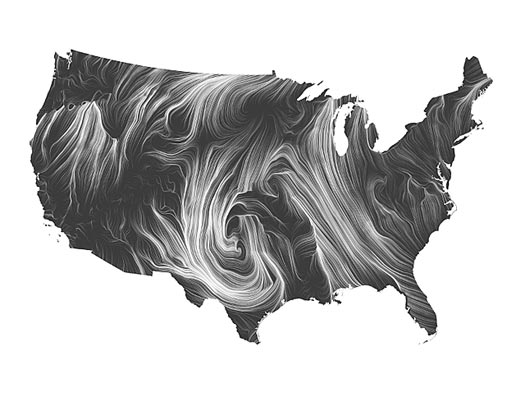
Science tattoos – these are some of my favorites
 (Above) Marc Morency, Quartermaster 1st class, USN, writes:
“My tattoo is the visual depiction of how to plot a line of position from a celestial body using the altitude intercept method, a method which has been time tested for more than a century. For me it serves as a reminder that while technology improves, the sea remains an unpredictable place and it is up to the older generation to teach the younger the old school ways of doing business.”
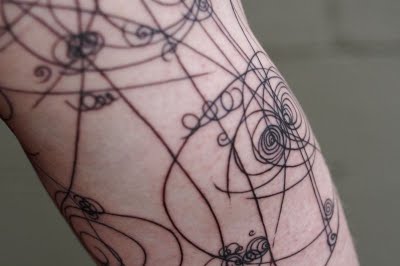
(Above) Zach writes: “This is a half sleeve up my upper right arm based around an image taken by one of the CERN bubble chambers. It is based on this image. I first saw that image my freshman year of college. It had the sublime, simple beauty that only something made of math and science can have. It stuck with me for 8 more years before I actually decided to get it etched into me. Oddly enough, on Valentine’s Day. I guess it was my Valentine’s to physics and science. Oh, and when people ask who drew it, I always respond ‘God.’”
–>
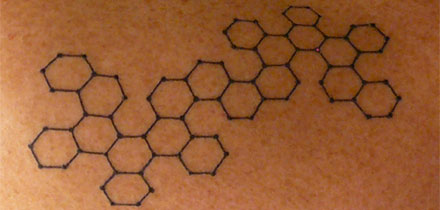
(Above) “For some time I have wanted to get a tattoo to depict my appreciation for meteorites. On September 28, 1969 meteorites fell in Murchison, Australia. On September 28, 2004 our daughter Christina (a.k.a. Pinky) was born. As if wasn’t already a top-fiver for it’s amino acids, Murchison quickly moved up the ranks of my favorite meteorites and I had decided it would somehow be involved in the meteorite tattoo. With a little help from friends Steve Arnold (IMB) and Jason Phillips I obtained a small capsule of Murchison crumbs to pulverize and one day add to the ink. I ultimately decided on a carbon buckeyball, found in Murchison, unrolled and laid out flat. With Murchison fully represented in design and medium, I had the tattoo artist make one carbon atom bright pink in honor of Pinky. Although it’s only the size of the head of a pin, it means the world to her… and me.”
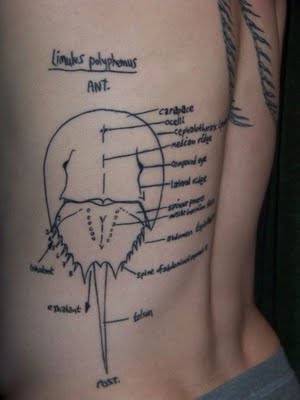
(Above) Loren, a biology graduate student, writes, “It’s a sketch of the horseshoe crab Limulus, such as a zoologist would make (and with the abdominal segments correctly identified). Perhaps the most magnificent living fossil of all, the horseshoe crab is the survivor of a lineage that extends back some 445 million years into the Ordovician. The four extant species are the only living representatives of the ancient arthropod class Merostomata and the only known chelicerate crabs.”
–>
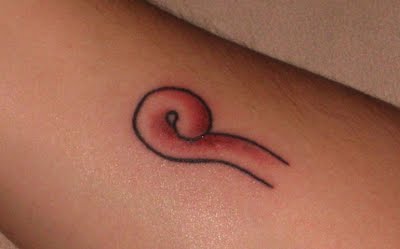
(Above) Alice writes, “This is an Aztec speech glyph that dates back before the conquest. I’m a linguist, and I believe this glyph embodies the impossible elegance of spoken language as well as the intrinsically artificial and cumbersome nature of written language.”
–>
(Above) Mark writes:
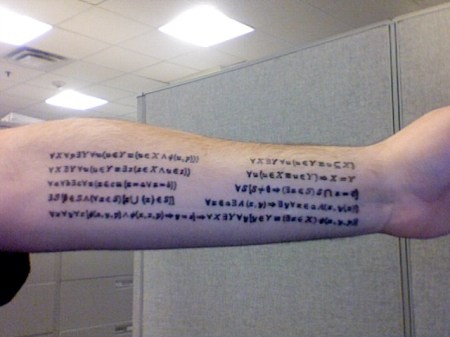
“This tattoo is the Zermelo-Fraenkel with Choice axioms of set theory. These nine axioms are the basis for ZFC set theory, which is the most commonly studied form of set theory and the most well known set of axioms as well. From these nine axioms, one can derive all of mathematics. These provide the foundation of mathematics, a field that you can likely tell that I love dearly.”
–>
(Above) Alison, a high-school physics teacher, writes:
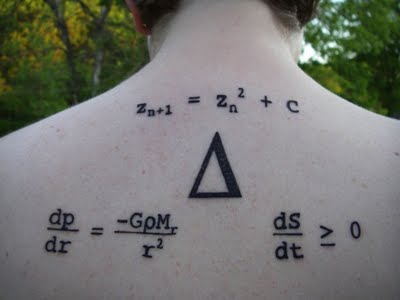
“Like many scientists, the wonder of the natural laws of the Universe is where I draw my spiritual inspiration. I also study the religions of the world, and have been fascinated by the reoccurring theme of Creation, Preservation, and Destruction. The Mandelbrot Set (top) represents Creation, with the emergent properties of a simple equation that produces such a rich, complex, and unpredictable fractal pattern that goes on into Infinity. The equation for hydrostatic equilibrium (bottom left) represents Preservation, describing the precarious balance between crushing gravity and expanding pressure inside of stars (including our own) to keep them in a stable, sustainable size for billions of years. The equation describing entropy (bottom right) symbolizes Destruction, simply stating that this fundamental break down of systems and accumulation of disorder either increases or stays the same over time, but never decreases. All three circle around the Delta, the symbol for Change.”
–>
(Above) Milad writes:
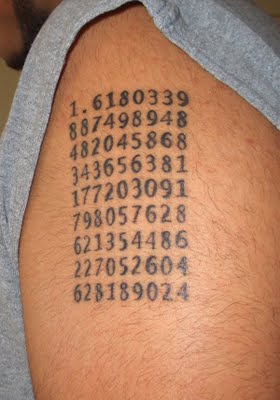
“I am a Mechanical Engineering undergrad at UC Berkeley and I got this tattoo about a month ago. It’s the golden ratio in the shape of a rectangle, with the ratio of the sides of the rectangle actually being the golden ratio! I have been obsessed with this number since I heard about it in high school, and it is the reason why I became so fascinated with mathematics. The golden ratio is known to be the closest mathematical explanation of beauty. It has been used a lot in architecture, art, and music around the world, and has some amazing mathematical and geometrical properties.”

–>
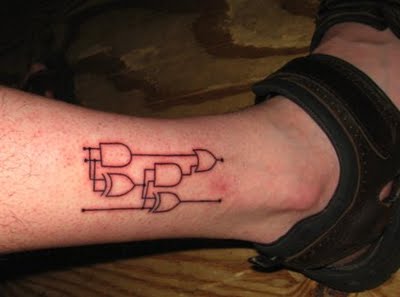
(Above) “This tattoo is the schematic for the reference point of electricity. I just think of it as the source of electricity. Its really either the point at which you consider voltage to be 0, or in this pictures case, the physical connection to the earth (hence the lower calf). Electronics has been my passion for as long as I can remember, and I feel like this tattoo doesn’t do it justice. So I plan on getting another one to incorporate my passion for electronics and my trans-humanism beliefs.”
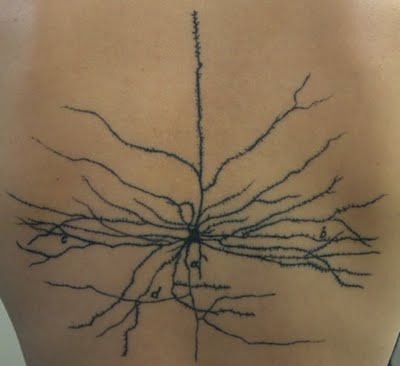
(Above) Anonymous writes: “This is a ‘Ramon y Cajal’ drawing of a human motor cortex pyramidal cell. I am a student of neuroscience and greatly admire Ramon y Cajal not only for his scientific contributions but for the artistic and beautiful quality of his images. This image reminds me of the vast and incredible power of the neocortex, and of the amazing capability of the human body.”
From Accidental Mysteries
From Science Tattoos – Carl Zimmer
With thanks to HMS Defiant














 Gunsmoke and Knitting