On Saturday, we went to an estate sale in a nearby suburb. The neighborhood is full of trees and ponds and twisty roads. The house above is the neighbor of the estate sale. They share a pond in their backyards. I really wanted to knock on this door to see inside, but restrained myself. What fun to have an observatory dome on the roof of your house! This is something I have often contemplated, but these folks went for it. Bravo.
Today marks the winter solstice – the beginning of the story-telling season, the time when the earth’s northern hemisphere is at its maximum axial tilt away from the sun, the day when your noontime shadow is the longest it is going to be all year. So break out your cakes and ale, light some sparklers, and call back the sun!
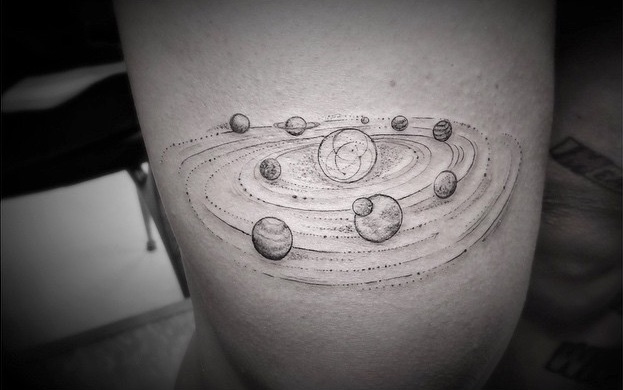
Because it is tattoo Tuesday – here is one I liked . . .
There are more interesting solstice mandalas over at deviant art.
Today the earth is traveling through the debris (why call it that?) stream of Halley’s Comet. The focal point of the meteors is just above the constellation Orion. Spaceweather says that the best viewing is to look southeast when the sky is still dark before dawn. So then, overcast in my neighborhood.
As the shower intensifies on Oct. 20th, the Canadian Meteor Orbit Radar (CMOR) near Tavistock, Ontario, is picking up echoes from the constellation Orion. The bright pink “hot spot” in this radar sky map shows where bits of Halley’s Comet are distintegrating approximately 100 km above Earth’s surface.
I would like to see the auroras like this. I did catch a glimpse of them on a night-time drive in the middle of New York state when I was traveling with friends between Boston and Ohio. I also saw them briefly in a dark sky area of Ohio. But nothing as dramatic as this video. I don’t remember hearing any music, either.
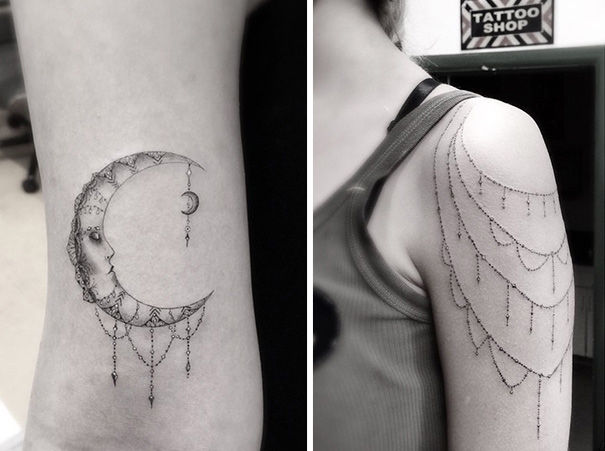
Tattoo artist Brian Woo’s dad wanted him to be a doctor, but instead of textbooks, Woo began to experiment with tattoos at 13. Soon he was apprenticed at Shamrock Social Club in LA, where stars like the Sex Pistols, Tupac, and Johnny Depp have been tattooed and waiting lists can be over a year long.
The Doctor describes his technique as fine line black and grey. And the tattoo that made him famous? “A wolf made up of my constellations – the first time I used my signature circles and lines to create an image,” he said.
I always thought it was remarkable that astronomers found little, bitty Pluto at all – and now we are getting color photos of Pluto and Charon. Captured by Ralph and Alice – perfect.
Pluto and Charon photographed by the cameras Ralph and Alice on the New Horizons spacecraft.
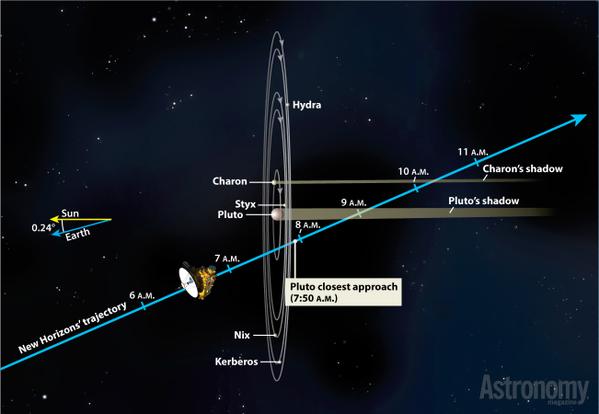
In a historic first – just one of many that will be made over the next several months, to be sure! – the New Horizons spacecraft captured its first color image of Pluto and its partner/satellite Charon on April 9 from a distance of 71 million miles – about equivalent to that between Venus and the Sun. The orange blobs above are the two worlds locked in an orbital dance a mere 12,200 miles apart… that’s 20 times less than the distance between Earth and the Moon!The image was captured with New Horizons’ “Ralph” instrument, a Multispectral Visible Imaging Camera (MVIC) built for the mission by Ball Aerospace (which is a spinoff of the same company that became famous in the U.S. for its glass canning jars.)
Ralph is one of six science instruments aboard New Horizons; it is paired with “Alice,” an ultraviolet imaging camera. (Think Ralph and Alice Kramden.) When New Horizons makes its close pass by Pluto and Charon on July 14 these cameras will capture details of the icy worlds like never before seen.
Ralph will be the main eyes for New Horizons during its July flyby. it will capture images of Pluto’s surface to a resolution of 250 meters (850 feet) per pixel and also be able to map surface temperatures as well as scan for the presence of nitrogen, water, and carbon monoxide.
“This is pure exploration; we’re going to turn points of light into a planet and a system of moons before your eyes!” said Alan Stern, New Horizons principal investigator from Southwest Research Institute (SwRI) in Boulder, Colorado. “New Horizons is flying to Pluto — the biggest, brightest and most complex of the dwarf planets in the Kuiper Belt. This 21st century encounter is going to be an exploration bonanza unparalleled in anticipation since the storied missions of Voyager in the 1980s.”
Traveling over 31,000 mph New Horizons is now within 1 AU of Pluto and Charon and getting closer every day, every hour, every second. This image is only a hint at what we’ll soon be seeing from this far-flung member of our planetary family!
There was no viewing of the event in my neck of the woods – it’s still snowing.
Three Worlds, One Shot: a February 2015 Conjunction Event
Did you have clear skies last night? If so, you may have been able to catch the sight above: a conjunction of the crescent Moon and the planets Venus and Mars in the western sky!
I captured the photo above with a Nikon D7000 and a Sigma 150-500mm lens. Venus is the brighter object at left, Mars appears dimmer and redder above. Part of the Moon’s “dark side” can be seen due to Earthshine – sunlight reflected off Earth onto the Moon. (Sometimes romantically called “the old Moon in the new Moon’s arms.”)
Although the worlds were only within a degree or two of each other in the sky they were in reality very far apart (obviously). The actual distances from Earth to each at the time of the event? Moon: 363,784 km; Venus: 213 million km; Mars: 329.1 million km.























 Gunsmoke and Knitting