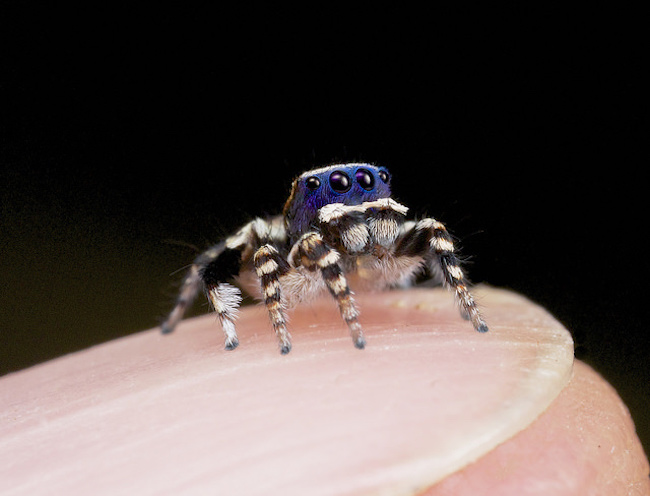
This little spider puts his heart into his dancing – all for the benefit of the little brown female seen at the end of the video. The colorful fellow is M. personatus, or Blueface peacock spider. Jurgen Otto is a spider and mite biologist from Australia who is interested in creatures such as the peacock spider, from a scientific perspective as well as for its entertaining dancing.
John Travolta, eat your heart out. “Unh, unh, unh, unh . . . ”
Volcano Calbuco erupted on April 22, 2015, for the first time in four decades. Located close to the cities of Puerto Varas and Puerto Montt in southern Chile. We (Jonas Dengler and Martin Heck) spend the prior couple of days on the neighboring volcano Osorno (~20km linear distance) shooting timelapses. After an amazing night under the nightsky we took the cable car downwards after a delay caused by repairs. Already late we headed south to catch the ferry on Routa 7 down to Patagonia. After 10min on the ferry we noticed a massive, almost nuclear looking cloud boiling upwards just were we left a few hours ago. Frenetically looking for a good outlook we then rushed to the only non-forested place to get a decent view of the show. We quickly put every bit of camera-equipment we could find on the constantly growing mushroom-cloud. We shot timelapses in 8K and 4K with a Pentax 645Z and Canon 6D. On the A7s we shot 4K video to the Shogun using Kingston HyperX SSDs. We filled almost all of our memory cards in the prior night so I had to do backups while shooting all this stuff.
This was for sure the most incredible show I’ve ever seen. I think this is a once in a lifetime event and I am so happy that we were able to capture it in all its glory.
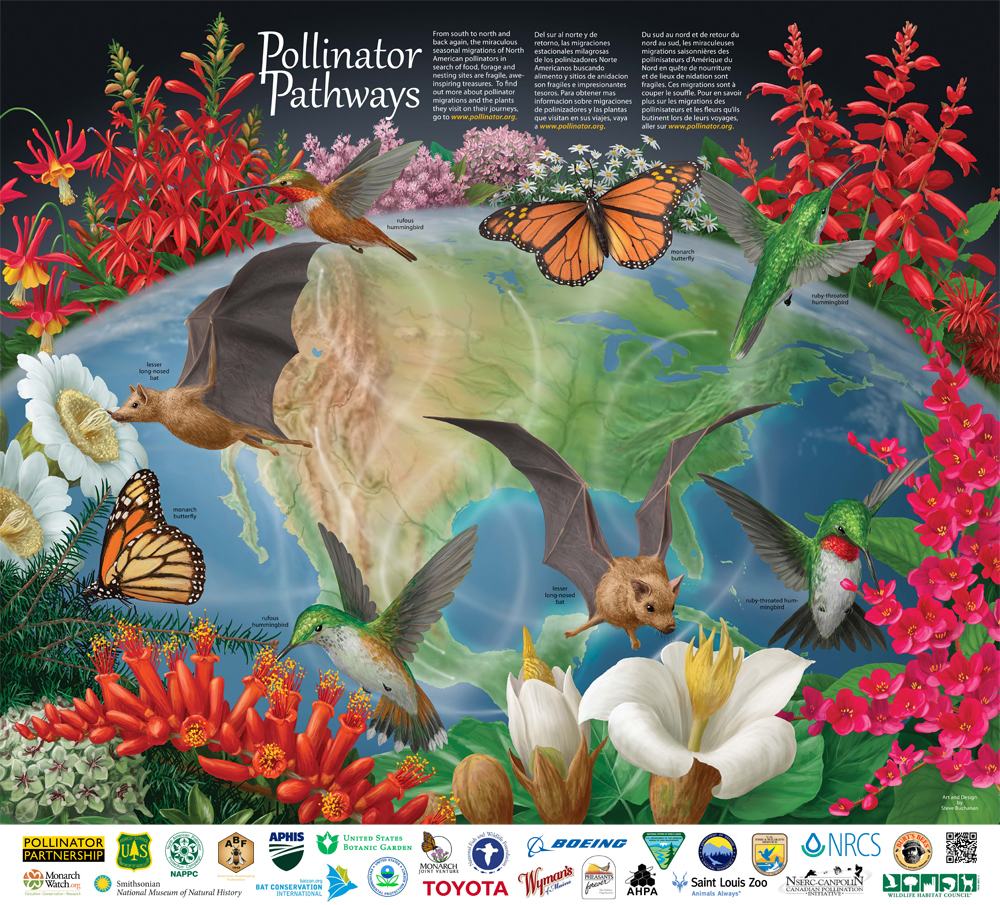
It’s Pollinator Week! From butterflies and bees to hummingbirds and beetles, these small but mighty species are important to our everyday lives. Without them, we would have fewer fruit, vegetables and nuts – not to mention chocolate and coffee. Learn more: http://on.doi.gov/1R1OFXQ
While I find my cats extremely beautiful and endlessly fascinating, on this sappy cat Friday, the blog is featuring deep sea life. I really like the little creature at the start of this video. There is so much more to know about our oceans. Some say it should take precedence over space travel. I don’t think so. Why not do both.
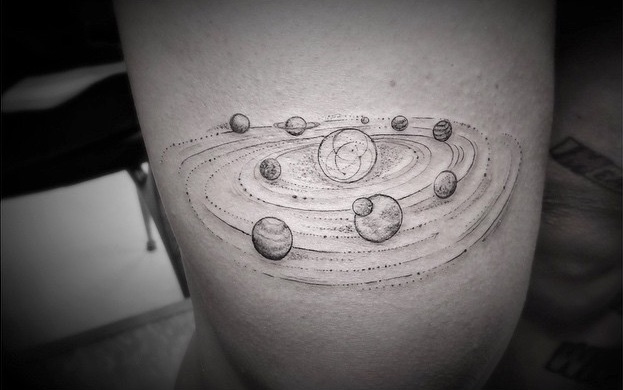
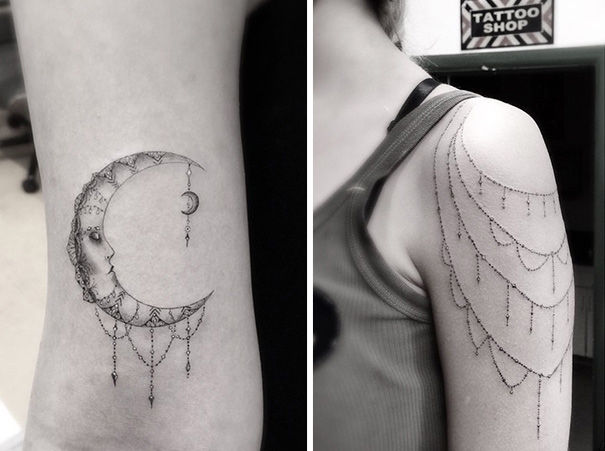
Tattoo artist Brian Woo’s dad wanted him to be a doctor, but instead of textbooks, Woo began to experiment with tattoos at 13. Soon he was apprenticed at Shamrock Social Club in LA, where stars like the Sex Pistols, Tupac, and Johnny Depp have been tattooed and waiting lists can be over a year long.
The Doctor describes his technique as fine line black and grey. And the tattoo that made him famous? “A wolf made up of my constellations – the first time I used my signature circles and lines to create an image,” he said.
I always thought it was remarkable that astronomers found little, bitty Pluto at all – and now we are getting color photos of Pluto and Charon. Captured by Ralph and Alice – perfect.
Pluto and Charon photographed by the cameras Ralph and Alice on the New Horizons spacecraft.
In a historic first – just one of many that will be made over the next several months, to be sure! – the New Horizons spacecraft captured its first color image of Pluto and its partner/satellite Charon on April 9 from a distance of 71 million miles – about equivalent to that between Venus and the Sun. The orange blobs above are the two worlds locked in an orbital dance a mere 12,200 miles apart… that’s 20 times less than the distance between Earth and the Moon!The image was captured with New Horizons’ “Ralph” instrument, a Multispectral Visible Imaging Camera (MVIC) built for the mission by Ball Aerospace (which is a spinoff of the same company that became famous in the U.S. for its glass canning jars.)
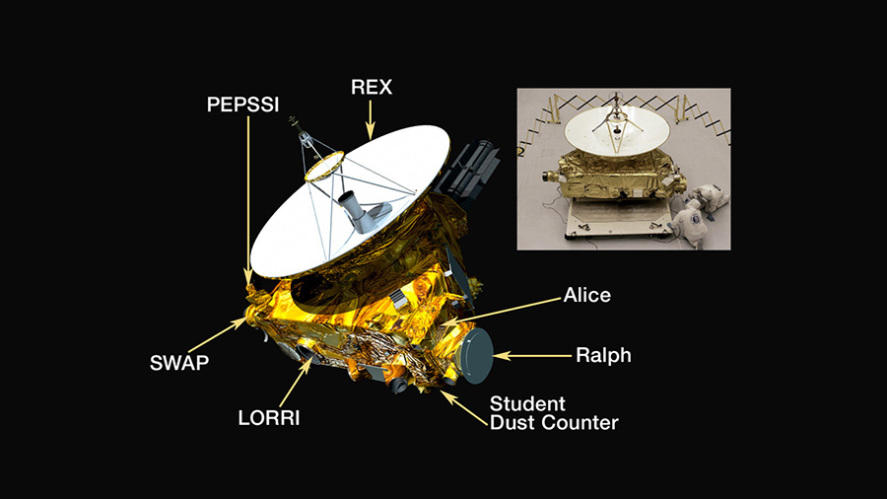
Ralph is one of six science instruments aboard New Horizons; it is paired with “Alice,” an ultraviolet imaging camera. (Think Ralph and Alice Kramden.) When New Horizons makes its close pass by Pluto and Charon on July 14 these cameras will capture details of the icy worlds like never before seen.
Ralph will be the main eyes for New Horizons during its July flyby. it will capture images of Pluto’s surface to a resolution of 250 meters (850 feet) per pixel and also be able to map surface temperatures as well as scan for the presence of nitrogen, water, and carbon monoxide.
“This is pure exploration; we’re going to turn points of light into a planet and a system of moons before your eyes!” said Alan Stern, New Horizons principal investigator from Southwest Research Institute (SwRI) in Boulder, Colorado. “New Horizons is flying to Pluto — the biggest, brightest and most complex of the dwarf planets in the Kuiper Belt. This 21st century encounter is going to be an exploration bonanza unparalleled in anticipation since the storied missions of Voyager in the 1980s.”
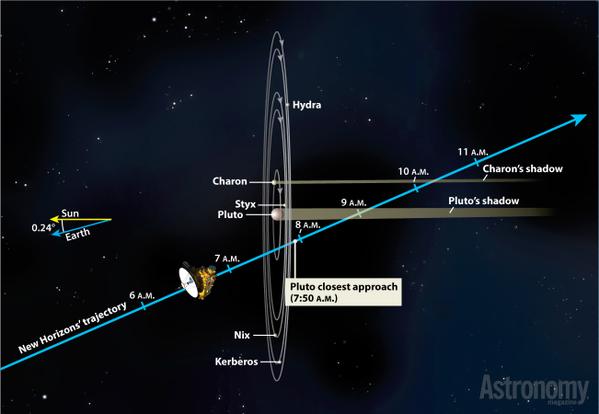
Traveling over 31,000 mph New Horizons is now within 1 AU of Pluto and Charon and getting closer every day, every hour, every second. This image is only a hint at what we’ll soon be seeing from this far-flung member of our planetary family!
There was no viewing of the event in my neck of the woods – it’s still snowing.
Three Worlds, One Shot: a February 2015 Conjunction Event
Did you have clear skies last night? If so, you may have been able to catch the sight above: a conjunction of the crescent Moon and the planets Venus and Mars in the western sky!
I captured the photo above with a Nikon D7000 and a Sigma 150-500mm lens. Venus is the brighter object at left, Mars appears dimmer and redder above. Part of the Moon’s “dark side” can be seen due to Earthshine – sunlight reflected off Earth onto the Moon. (Sometimes romantically called “the old Moon in the new Moon’s arms.”)
Although the worlds were only within a degree or two of each other in the sky they were in reality very far apart (obviously). The actual distances from Earth to each at the time of the event? Moon: 363,784 km; Venus: 213 million km; Mars: 329.1 million km.



















 Gunsmoke and Knitting