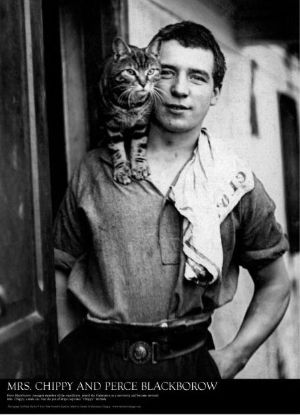
Perce Blackborow and Mrs. Chippy (really a tom) both members of Ernest Shackleton’s crew on the Endurance.

Perce Blackborow and Mrs. Chippy (really a tom) both members of Ernest Shackleton’s crew on the Endurance.
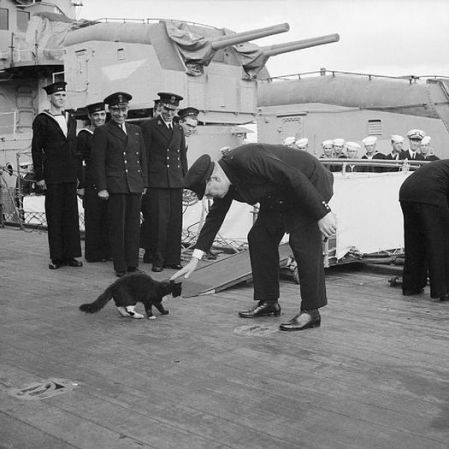
Prime minister Winston Churchill strokes Blackie goodbye, the ship’s cat of HMS Prince of Wales, as he is about to cross the gangway to the USS McDougal (DD-358), an American destroyer, during a ceremonial visit in 1941.
-Wikipedia

The Scandinavian community of Metropark Centralis, including those from Norway, Sweden, Finland, Denmark and Iceland gathered at the bust of Leif Ericson in front of Shooters in Cleveland’s Flats. Leif Ericson was a Norse explorer regarded as the first European to land in North America (excluding Greenland), nearly 500 years before Christopher Columbus.

According to the Sagas of Icelanders, he established a Norse settlement at Vinland, tentatively identified with the Norse L’Anse aux Meadows on the northern tip of Newfoundland in modern-day Canada.
In 1964 the United States Congress authorized and requested the president to proclaim October 9 of each year as “Leif Erikson Day”. Each year local Scandinavians meet at the bust of the exploerer which is in front of Shooter’s restaurant in the Flats. Here they toast Ericson and his maritime accomplishments with a drink of Aquavit, a 40 proof Scandinavian liqueur. Aquavit is said to get its special flavor from its trip to the Equator.
That’s right; Aquavit is placed in barrels and put on a ship bound for Australia. It must pass the Equator and return to get the right flavor. All of the sloshing in the barrels on the long ocean trip makes the drink unique. It also has a distinctive flavor, partially because of spices such as caraway. Skol!
Histories have been written and more will be written of the Norwegians in America, but no man can tell adequately of the tearing asunder of tender ties, the hardships and dangers crossing the deep, the work and worry, the hopes and fears, the laughter and tears, of men and women who with bare hands carved out of a wilderness a new kingdom.– Rønning, N. N., from the book Fifty Years in America
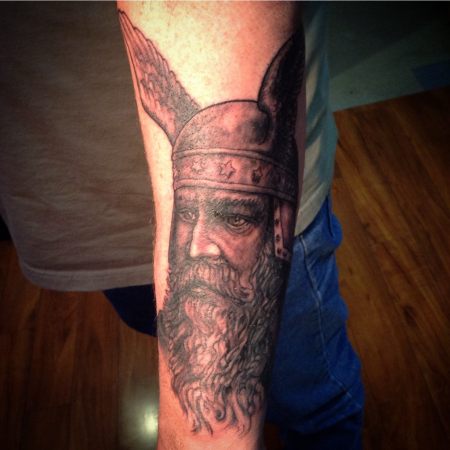
Leif Erikson Day was yesterday, but today is Tattoo Tuesday!
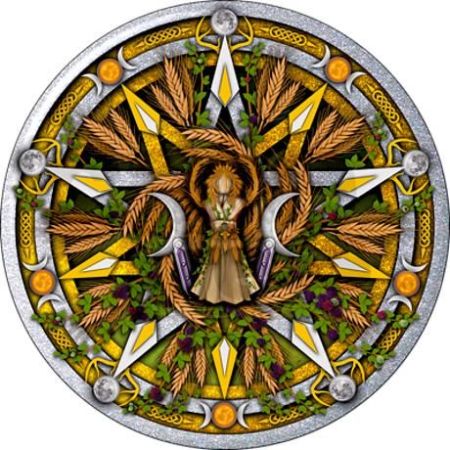
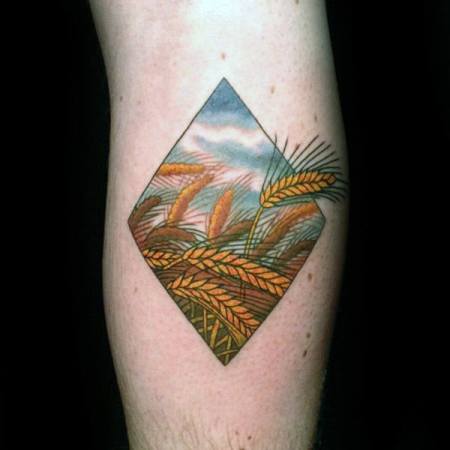
Today is Lammas, or “loaf mass.” Traditionally, it is the first harvest festival of the season, marking the beginning of the wheat harvest and is celebrated, naturally, by baking bread. On this day in the Anglo-Saxon tradition, it was customary to bring to church a loaf of bread made from wheat from the new crop.
So, it is August 1 – go bake some bread and don’t forget to say “rabbit, rabbit.”
It is also tattoo Tuesday:

The Fire of Rome by Hubert Robert
“[One July 18, in] 64 A.D., a great fire ravaged Rome for six days, destroying 70 percent of the city and leaving half its population homeless. According to a well-known expression, Rome’s emperor at the time, the decadent and unpopular Nero, “fiddled while Rome burned.” The expression has a double meaning: Not only did Nero play music while his people suffered, but he was an ineffectual leader in a time of crisis. It’s been pretty easy to cast blame on Nero, who had many enemies and is remembered as one of history’s most sadistic and cruelest leaders—but there are a couple of problems with this story.
For one thing, the fiddle didn’t exist in ancient Rome. Music historians believe the viol class of instruments (to which the fiddle belongs) was not developed until the 11th century. If Nero played anything, it would probably have been the cithara, a heavy wooden instrument with four to seven strings—but there is still no solid evidence that he played one during the Great Fire. The Roman historian Tacitus wrote that Nero was rumored to have sung about the destruction of Troy while watching the city burn; however, he stated clearly that this was unconfirmed by eyewitness accounts.
When the Great Fire broke out, Nero was at his villa at Antium, some 35 miles from Rome. Though he immediately returned and began relief measures, people still didn’t trust him. Some even believed he had ordered the fire started, especially after he used land cleared by the fire to build his Golden Palace and its surrounding pleasure gardens. Nero himself blamed the Christians (then an obscure religious sect) for the fire, and had many arrested and executed. But while Nero may have been guilty of many things, the story of him fiddling while Rome burned belongs firmly in the category of popular legend rather than established truth.”
quoted from the History Channel site
It is tattoo Tuesday:


“Don’t you just hate it when you work hard for something and someone just walks over your work — literally? Well, we don’t really know how any Romans would feel after a cat walked over their roof tiles, but now, after almost two millennia, it’s nothing but cute.
The tile dates from 100 AD, from a Roman site in Lincolnshire, UK. Archaeologists found it along with over one thousand other pieces, by the Washingborough Road site, excavated due to railway works in the area. Scientists believe that the site was a complex of buildings, perhaps a town or a smaller settlement, which included some pretty wealthy people. Most houses during that time would have been built of timber and thatch. This is also likely because many of the buildings excavated there were made of stone and bricks and had tiled roofs — indicating some pretty wealthy Romans lived in the area. This was likely part of a big villa, as archaeologists even found a fish pound around.
The tiles were made through a relatively common technique. Most craftsmen would have made the tiles close to the settlement. The wet clay was molded into the desired shape and then left out to dry — it’s then that our cat would have stepped on it, sinking ever so slightly into the drying clay and leaving a print that would live on for posterity.
It’s known that Romans kept cats as pets, mostly to keep the mice and rats away.
Aside from Roman artifacts, the site has revealed a trove of other findings. Flints from hunter-gatherers, arrows and other weapons from Neolithic hunters, Bronze-Age burial urns, even human ashes were all retrieved from the area, which seems to have been continuously inhabited for a very long time. Moving on closer to the present date, archaeologists have also discovered a Medieval malthouse and pre-modern farmhouse. Still, if you ask me, nothing quite compares to the charm of this small paw print.”
From the Lincolnshire News: Read more here.
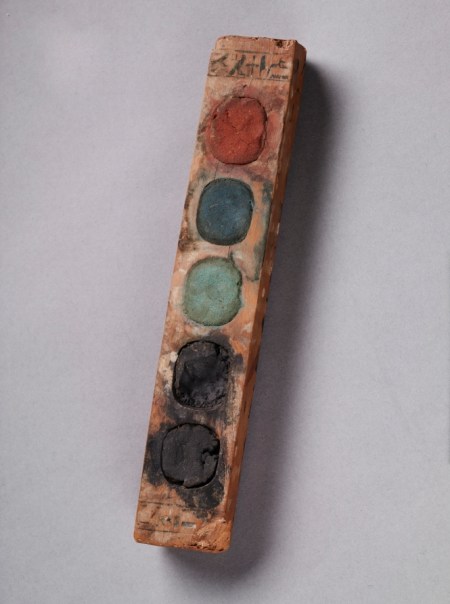
Paint Box of Vizier Amenemope, c. 1427-1401 BC
Egypt, New Kingdom, Dynasty 18 (1540-1296 BC), reign of Amenhotep II
This paint box still preserves its original cakes of pigment: one cake each of red (red ocher), blue (Egyptian blue), green (a mixture of Egyptian blue, yellow ocher, and orpiment) and two of black (carbon black, from charcoal). It belonged to Amenemope, who was vizier, or prime minister, under Amenhotep II. Amenemope probably used his paint box for recreation.
This little 3,000 year old gem is in the collection of the Cleveland Museum of Art. While it is not currently in the galleries, it was quite a thrill to see it when it was on exhibit. Obviously a well and fondly used possession, seeing it transported me back in time.
Firearms, fibers, any news or behaviors that make me say, "hmm, let me take another look at this."
I still miss my man, but my aim is getting better.









 Gunsmoke and Knitting