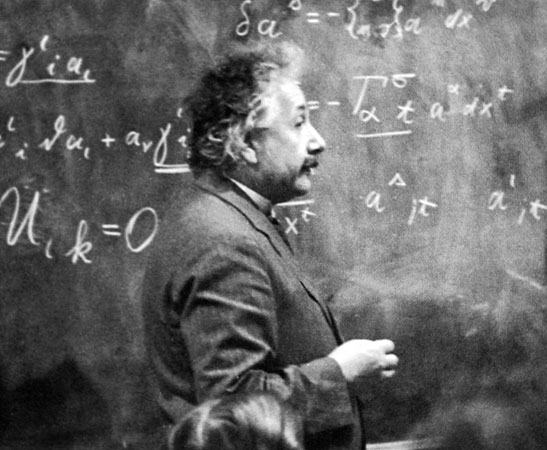
It is an important day in science relatively speaking – the 107th anniversary of Einstein’s publication of the Theory of Relativity.
Here is a little video that explains how Einstein came up with the equation:

It is an important day in science relatively speaking – the 107th anniversary of Einstein’s publication of the Theory of Relativity.
Here is a little video that explains how Einstein came up with the equation:

(U.S. Navy Military Sea Lift Command)
No, not wine or grog, but jet fuel, using seawater, and they have a lot of that. . .
Refueling Navy vessels at sea can prove in many ways to be a costly endeavor. The U.S. Naval Research Laboratory (NRL) is developing the chemistry for producing jet fuel from renewable resources in theater. The process envisioned would catalytically convert CO2 and H2 directly to liquid hydrocarbon fuel used as JP-5.
“The potential payoff is the ability to produce JP-5 fuel stock at sea reducing the logistics tail on fuel delivery with no environmental burden and increasing the Navy’s energy security and independence,” says research chemist, Dr. Heather Willauer.
How it Works: CO2 + H2 = Jet Fuel
NRL has developed a two-step process in the laboratory to convert the CO2 and H2 gathered from the seawater to liquid hydrocarbons. In the first step, an iron-based catalyst has been developed that can achieve CO2 conversion levels up to 60 percent and decrease unwanted methane production from 97 percent to 25 percent in favor of longer-chain unsaturated hydrocarbons (olefins).
In the second step these olefins can be oligomerized (a chemical process that converts monomers, molecules of low molecular weight, to a compound of higher molecular weight by a finite degree of polymerization) into a liquid containing hydrocarbon molecules in the carbon C9-C16 range, suitable for conversion to jet fuel by a nickel-supported catalyst reaction.
Many thanks to HMS Defiant, who is tolerant of my obsession with polymers, for this reference.
I’m a little slow on the uptake, but September 22 was International Observe the Moon Day. Thanks to Lights in the Dark for recommending this amazing video. I’ve got my bags all packed for the next shuttle . . . oh, never mind.
And for stars of a completely different nature, go read Millenium Conjecture.

I was interested to read Why, Because Science’s recent post on awesome minerals. I also had a geological experience just last weekend. I attended a blingie bead trunk show with a friend, but was seduced by the beads that were fashioned from rocks and minerals. Being struck helpless, I was forced to buy several specimens for my collection and they are:
From the left
Sardonyx – this really has a very nice chevron pattern that is difficult (impossible) to see in this photo
Gray Brecciated Jasper – with some quartz crystal inclusions
Lapis
Petrified Wood Jasper
African Turqoise – I may turn this into a necklace – I really like it
Labradorite – this one shows a nice play of colors known as labradorescence
These are all beads and are drilled along the long axis, but I wanted them for my rock and mineral collection. The largest pieces are 30 x 40 mm.
This beautiful video is by John Eklund. I saw it first at Lights in the Dark’s Twitter site and wanted to share. I could get lost in this video.

Seen on PopSci, the robot cheetah, developed by Boston Dynamics, set a new land speed record of 28.3 miles per hour –
The article also says that while the Cheetah runs tethered to an external power supply, they are about to launch the Wildcat which needs no external support. I have included the photos of the real cheetahs because this is Sappy Cat Blogging.

photo credit: Smithsonian
I came across this video in a reference on Why. Because Science. And it features my favorite astrophysicist. It also features Larry Krause and Richard Feynman.
I remember hearing this concept for the first time (for me) from Carl (Billions and Billions) Sagan on Cosmos.
Enjoy.
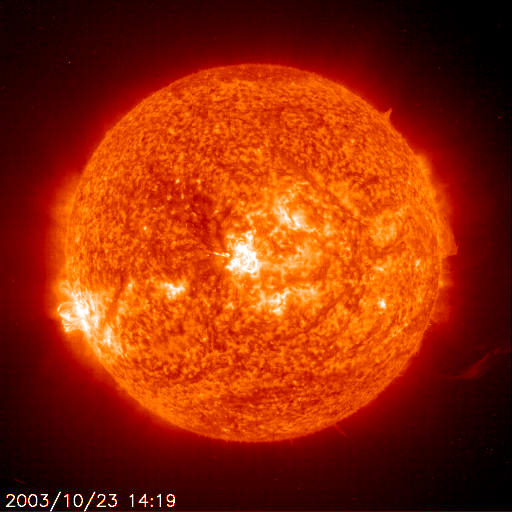
Some more astronomy stuff.
I saw this on the Space Weather site yesterday. A great video showing a solar flare.
And was reminded by Lights in the Dark about the Astronomy Picture of the Day site and this video featuring a fictional journal to the middle of our galaxy. (I probably did not have to say that it was fictional.)
I had forgotten about APOD. I find the site fascinating and they have begun to add videos since I last visited. I love this stuff.

Photo credit: NASA

June 30 marks the 104th anniversary of the Tunguska Impact. This event was not well recognized at first. It happened in a remote location; 1908 was a time of political unrest in Russia; and the seismic activity from the event could have come from a number of sources.
The origin, track and outcome of the explosion that took place in the early morning on June 30 are still under debate by scientists.
Some have concluded that it was a near earth asteroid that came really near. A group of Italian scientists proposethat Lake Cheko in western Siberia might be a crater formed when a chunk of debris broke off the cosmic object and created a trench that then became the lake. The most often discussed possibility is that a comet, or piece of a comet, entered earth’s atmosphere and exploded before impact.
According to an eye witness who was questioned by an investigative team,
Suddenly in the north sky… the sky was split in two, and high above the forest the whole northern part of the sky appeared covered with fire… At that moment there was a bang in the sky and a mighty crash… The crash was followed by a noise like stones falling from the sky, or of guns firing. The earth trembled.
Most dramatic are the photographs of trees that were burned and blasted away from the impact, losing their branches and looking list the results of a clear cut on the most massive scale.
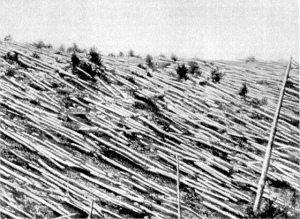
Tunguska remains a mystery and a talking point among scientists and lay people to this day,
“If you want to start a conversation with anyone in the asteroid business all you have to say is Tunguska,” says Don Yeomans, manager of the Near-Earth Object Office at NASA’s Jet Propulsion Laboratory. “It is the only entry of a large meteoroid we have in the modern era with first-hand accounts.”
References:

The Man of Numbers by Keith Devlin. This is the story of Leonardo of Pisa, now known as Fibonacci, who essentially invented modern arithmetic. He took number out of the context of merely keeping track of things and set the stage for fields such as technology, design, and commerce to develop and prosper
“The change in society brought about by the teaching of modern arithmetic was so pervasive and all-powerful that within a few generations people simply took it for granted. There was no longer any recognition of the magnitude of the revolution that took the subject from an obscure object of scholarly interest to an everyday mental tool. Compared with Copernicus’s conclusions about the position of Earth in the solar system and Galileo’s discovery of the pendulum as a basis for telling time, Leonardo’s showing people how to multiply 193 by 27 simply lacks drama.“
Remember the Powers of Ten video? This is a similar concept, but explores the Fibonacci Sequence in nature:
I found this on Brain Pickings as I noodling around following links for the upcoming transit of Venus on June 5-6.
Firearms, fibers, any news or behaviors that make me say, "hmm, let me take another look at this."
I still miss my man, but my aim is getting better.









 Gunsmoke and Knitting