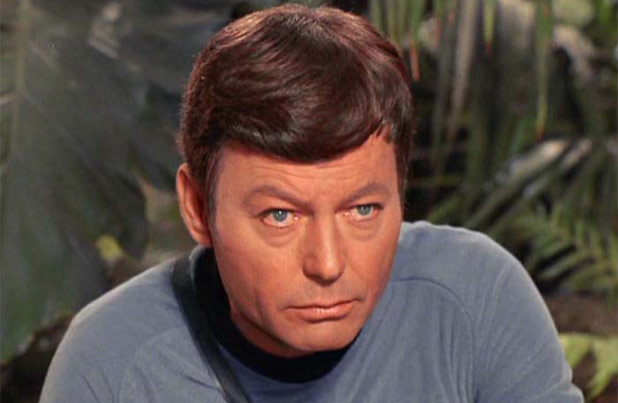
STARFLEET HISTORICAL FILE: McCoy, Leonard H. Mid-level Biography Brief Mode Final Rank: Admiral, retired Full Name: Leonard H. McCoy, M.D. Year of birth: 2227 Parents: Mr. and Mrs. David McCoy Education: University of Mississippi, 2245-49; medical school, 2249-53 Marital status: Divorced Children: A daughter, Joanna Quarters: Original Enterprise: 3F 127
Happy Birthday to Flash Gordon. This comic strip first appeared on January 7, 1934.
The comic strip follows the adventures of Flash Gordon, a handsome polo player and Yale graduate, and his companions Dale Arden and Dr. Hans Zarkov. The story begins with Earth bombarded by fiery meteors. Dr. Zarkov invents a rocket ship to locate their place of origin in outer space. Half mad, he kidnaps Flash and Dale, whose plane has crashed in the area, and the three travel to the planet Mongo, where they discover the meteors are weapons devised by Ming the Merciless, evil ruler of Mongo.
Flash Gordon later appeared in movies and on television, as well as in the comics.
Suomi NPP satellite image of North and South America at night
In daylight our big blue marble is all land, oceans and clouds. But the night is electric.
This image of North and South America at night is a composite assembled from data acquired by the Suomi NPP satellite in April and October 2012. The new data was mapped over existing Blue Marble imagery of Earth to provide a realistic view of the planet.
The nighttime view was made possible by the new satellite’s “day-night band” of the Visible Infrared Imaging Radiometer Suite. VIIRS detects light in a range of wavelengths from green to near-infrared and uses filtering techniques to observe dim signals such as city lights, gas flares, auroras, wildfires, and reflected moonlight. In this case, auroras, fires, and other stray light have been removed to emphasize the city lights.
Although the view looking down from space is of a sparkling show, the downside of course is light pollution over major metropolitan areas which impede the view of the night sky from the ground. (Find out more at the International Dark Sky Association site.)
Read more (and watch a video of these nighttime images of Earth) below:
“Artificial lighting is a excellent remote sensing observable and proxy for human activity,” says Chris Elvidge, who leads the Earth Observation Group at NOAA’s National Geophysical Data Center. Social scientists and demographers have used night lights to model the spatial distribution of economic activity, of constructed surfaces, and of populations. Planners and environmental groups have used maps of lights to select sites for astronomical observatories and to monitor human development around parks and wildlife refuges. Electric power companies, emergency managers, and news media turn to night lights to observe blackouts.
This video uses the Earth at night view created by NASA’s Earth Observatory with data processed by NOAA’s National Geophysical Data Center and combined with a version of the Earth Observatory’s Blue Marble: Next Generation.
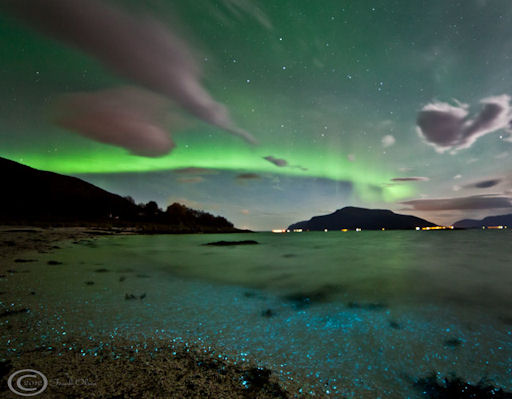
I thought this was a marvelous photograph. It was taken by Frank Olsen in Sortland, Norway. Reference is SpaceWeather.com. The photographer captured an impressive multitude of glowing things in this photo – the stars overhead, the green auroras, and the sparkling, luminescent dinoflagellates on the beach.
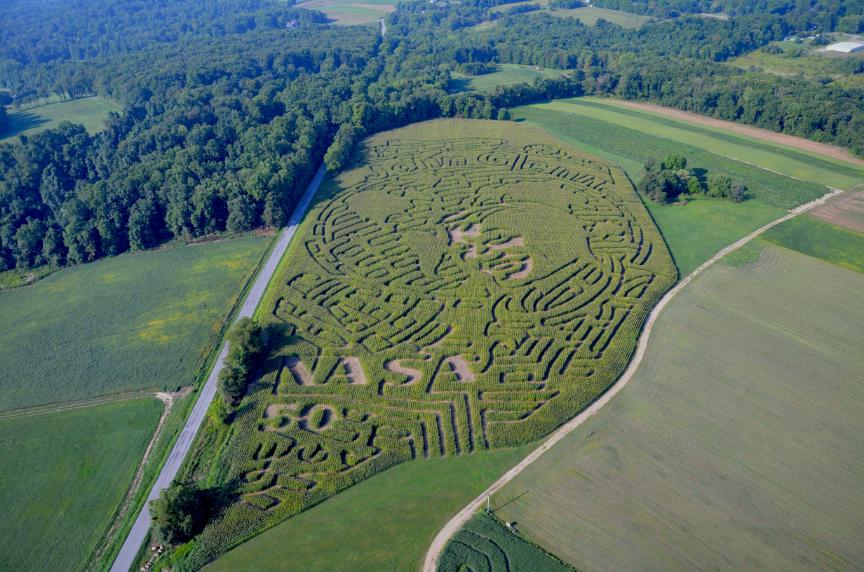
Crop circles? Messages from space?
Well, sort of. The Derthick family has constructed a corn maze that is an homage to Ohio astronaut and former U.S. Senator, John Glenn. The farm is located in Mantua, Ohio (in this part of the world, the town is pronounced MAN-a-way.)
Derthick’s publicity invites you to “come and be cornfused.”
I’m a little slow on the uptake, but September 22 was International Observe the Moon Day. Thanks to Lights in the Dark for recommending this amazing video. I’ve got my bags all packed for the next shuttle . . . oh, never mind.
June 30 marks the 104th anniversary of the Tunguska Impact. This event was not well recognized at first. It happened in a remote location; 1908 was a time of political unrest in Russia; and the seismic activity from the event could have come from a number of sources.
The origin, track and outcome of the explosion that took place in the early morning on June 30 are still under debate by scientists.
Some have concluded that it was a near earth asteroid that came really near. A group of Italian scientists proposethat Lake Cheko in western Siberia might be a crater formed when a chunk of debris broke off the cosmic object and created a trench that then became the lake. The most often discussed possibility is that a comet, or piece of a comet, entered earth’s atmosphere and exploded before impact.
According to an eye witness who was questioned by an investigative team,
Suddenly in the north sky… the sky was split in two, and high above the forest the whole northern part of the sky appeared covered with fire… At that moment there was a bang in the sky and a mighty crash… The crash was followed by a noise like stones falling from the sky, or of guns firing. The earth trembled.
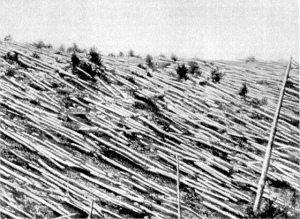
Most dramatic are the photographs of trees that were burned and blasted away from the impact, losing their branches and looking list the results of a clear cut on the most massive scale.
Tunguska remains a mystery and a talking point among scientists and lay people to this day,
“If you want to start a conversation with anyone in the asteroid business all you have to say is Tunguska,” says Don Yeomans, manager of the Near-Earth Object Office at NASA’s Jet Propulsion Laboratory. “It is the only entry of a large meteoroid we have in the modern era with first-hand accounts.”















 Gunsmoke and Knitting