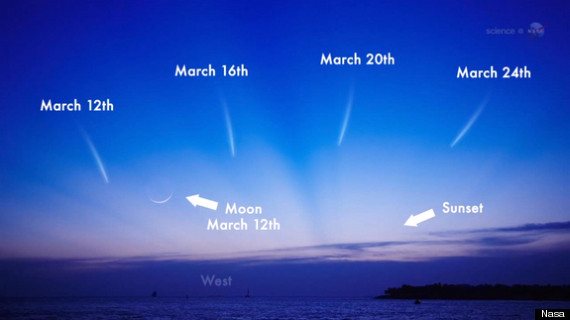
Thanks to HMS Defiant for this link to Comet PANSTARRS that will be visible soon in the northern hemisphere. Visibility here will depend a lot on the weather, but I will be looking for it.

Thanks to HMS Defiant for this link to Comet PANSTARRS that will be visible soon in the northern hemisphere. Visibility here will depend a lot on the weather, but I will be looking for it.
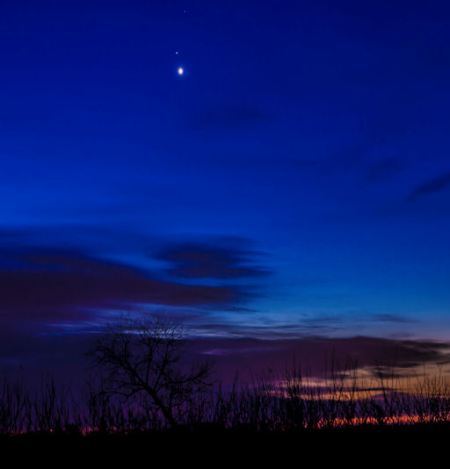
Besides the obvious benefits of a 7:00 am yoga class sometimes I get to see something like this, as I did last Wednesday. This is Venus in the early morning sky.

And on my way home from work that evening, I saw the new moon in the old moon’s arms. It’s a little hazy, but was still quite lovely. The light below the moon is a Lifeflight helicopter heading for the Cleveland Clinic.
Photo credit Venus: Cole Clark on Spaceweather
This post is a re-blog from Lights in the Dark – always a good read!

Suomi NPP satellite image of North and South America at night
In daylight our big blue marble is all land, oceans and clouds. But the night is electric.
This image of North and South America at night is a composite assembled from data acquired by the Suomi NPP satellite in April and October 2012. The new data was mapped over existing Blue Marble imagery of Earth to provide a realistic view of the planet.
The nighttime view was made possible by the new satellite’s “day-night band” of the Visible Infrared Imaging Radiometer Suite. VIIRS detects light in a range of wavelengths from green to near-infrared and uses filtering techniques to observe dim signals such as city lights, gas flares, auroras, wildfires, and reflected moonlight. In this case, auroras, fires, and other stray light have been removed to emphasize the city lights.
Although the view looking down from space is of a sparkling show, the downside of course is light pollution over major metropolitan areas which impede the view of the night sky from the ground. (Find out more at the International Dark Sky Association site.)
Read more (and watch a video of these nighttime images of Earth) below:
“Artificial lighting is a excellent remote sensing observable and proxy for human activity,” says Chris Elvidge, who leads the Earth Observation Group at NOAA’s National Geophysical Data Center. Social scientists and demographers have used night lights to model the spatial distribution of economic activity, of constructed surfaces, and of populations. Planners and environmental groups have used maps of lights to select sites for astronomical observatories and to monitor human development around parks and wildlife refuges. Electric power companies, emergency managers, and news media turn to night lights to observe blackouts.
This video uses the Earth at night view created by NASA’s Earth Observatory with data processed by NOAA’s National Geophysical Data Center and combined with a version of the Earth Observatory’s Blue Marble: Next Generation.
See more images and videos here: http://earthobservatory.nasa.gov/NightLights
NASA Earth Observatory image by Robert Simmon, using Suomi NPP VIIRS data provided courtesy of Chris Elvidge (NOAA National Geophysical Data Center).
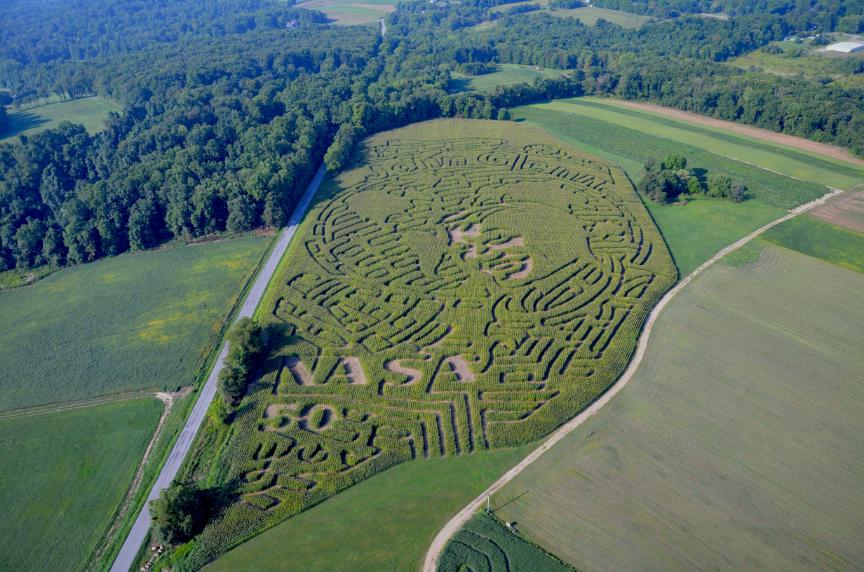
Crop circles? Messages from space?
Well, sort of. The Derthick family has constructed a corn maze that is an homage to Ohio astronaut and former U.S. Senator, John Glenn. The farm is located in Mantua, Ohio (in this part of the world, the town is pronounced MAN-a-way.)
Derthick’s publicity invites you to “come and be cornfused.”
I’m a little slow on the uptake, but September 22 was International Observe the Moon Day. Thanks to Lights in the Dark for recommending this amazing video. I’ve got my bags all packed for the next shuttle . . . oh, never mind.
And for stars of a completely different nature, go read Millenium Conjecture.
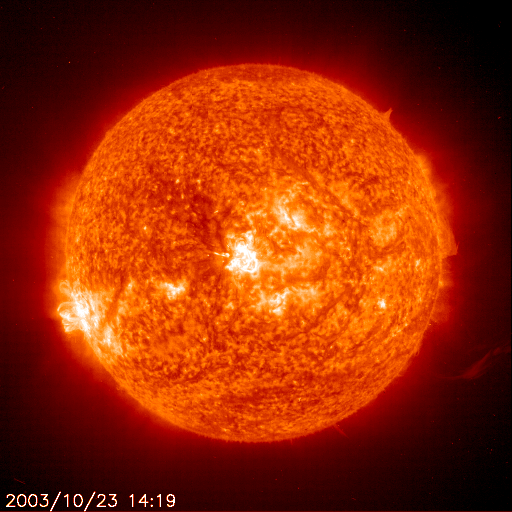
Some more astronomy stuff.
I saw this on the Space Weather site yesterday. A great video showing a solar flare.
And was reminded by Lights in the Dark about the Astronomy Picture of the Day site and this video featuring a fictional journal to the middle of our galaxy. (I probably did not have to say that it was fictional.)
I had forgotten about APOD. I find the site fascinating and they have begun to add videos since I last visited. I love this stuff.

Photo credit: NASA
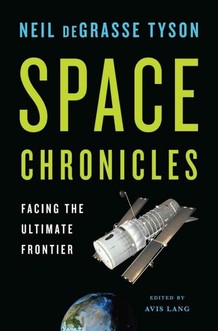
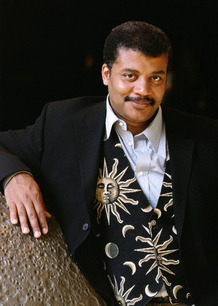
Neil deGrasse Tyson. I heard him yesterday on NPR talking about his new book, Space Chronicles: Facing the ultimate frontier. While I love space fiction, deGrasse Tyson defines the field of space exploration in practical terms. He holds that not only is the field full of wow, it is,
“. . . a force of nature unto itself that no other force in society can rival. Not only does that get people interested in sciences and all the related fields, [but] it transforms the culture into one that values science and technology, and that’s the culture that innovates. And in the 21st century, innovations in science and technology are the foundations of tomorrow’s economy.”
From the man who says, “Pluto is no longer a planet – get over it!” He also advises:
“What [the president] needs to say is, ‘We need to double NASA’s budget because not only is it the grandest epic adventure a human being can undertake, not only would the people who led this adventure be the ones we end up building statues to and naming high schools after and becoming the next generation’s Mercury 7 as role models, not only will there be spinoff products from these discoveries, but what’s more important than all of those, what’s more practical than all of those, is that we will transform the economy into one that will lead the world once again rather than trail the world as we are inevitably going to be doing over the next decade.’ “
Remember Zepharim Cochran High School? I think it’s time to lobby our representatives to make that happen in this reality.
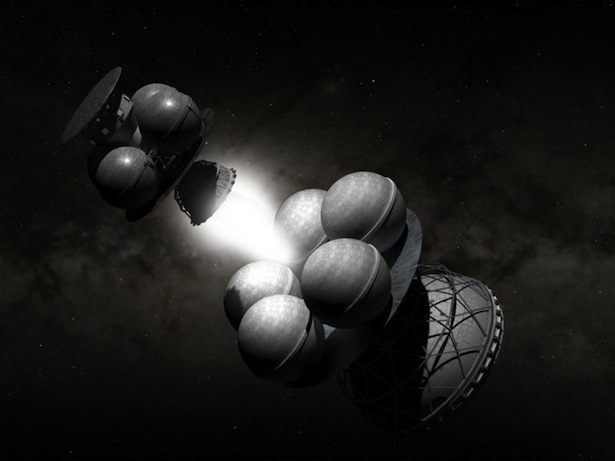
Project Icarus (reference from InstaPundit)
Once only the realm of science fiction with fine examples offered by Heinlein, Bradbury, Herbert and many others, inter-stellar travel is not only part of a feasibility study by the British Interplanetary Society, it has recently been added to the research agenda of the Defense Advanced Research Projects Agency (DARPA).
“Why do we pay this obsessive attention to backing up a document, which we can reproduce, when we pay no attention to backing up our civilization?” – Andreas Tziolas, Project Leader, Project Icarus
It’s about time.
Per Aspera Ad Astra – NASA Motto
Firearms, fibers, any news or behaviors that make me say, "hmm, let me take another look at this."
I still miss my man, but my aim is getting better.









 Gunsmoke and Knitting