Posts Tagged ‘geeky science blogging’

h1

What am I worrying about now?

May 17, 2012

When I was in elementary school, we learned the mnemonic, “Many very early men ate juicy steaks using no plates.”  This was a way to remember the solar system:  Mercury, Venus, Earth, Mars, Asteroids, Jupiter, Saturn, Uranus, Neptune, Pluto.  Note that Pluto was still a planet and was in its “proper” place.  This was presented as an orderly system with everything staying in its designated orbit.

The problem, it turns out, is that the solar system is far from orderly.  Pluto moves in an orbit that takes it occasionally inside the orbit of Neptune.  Comets are also part of the system and they turn up and swing around the sun willy-nilly.

The biggest worry is the, as I learned it, “asteroid belt.”  Well, it’s not a belt.  It’s not even a sash.  It is just a loose mess of rocks, and some of them come very close to the Earth – close enough to be considered dangerous, as reported in this story from NASA which posted yesterday:

Observations from NASA’s Wide-field Infrared Survey Explorer (WISE) have led to the best assessment yet of our solar system’s population of potentially hazardous asteroids. Also known as “PHAs,” these asteroids have orbits that come within five million miles (about eight million kilometers) of Earth, and they are big enough to survive passing through Earth’s atmosphere and cause damage on a regional, or greater, scale.

The NASA astronomers are predicting that there are 4,700 potentially hazardous asteroids that are near Earth’s orbit – give or take 1,500.  Yikes.

h1

Why was I looking up?

May 7, 2012

On May 5 the full moon achieved it closest approach to the earth at midnight.  This has been called a super moon and is explained here.

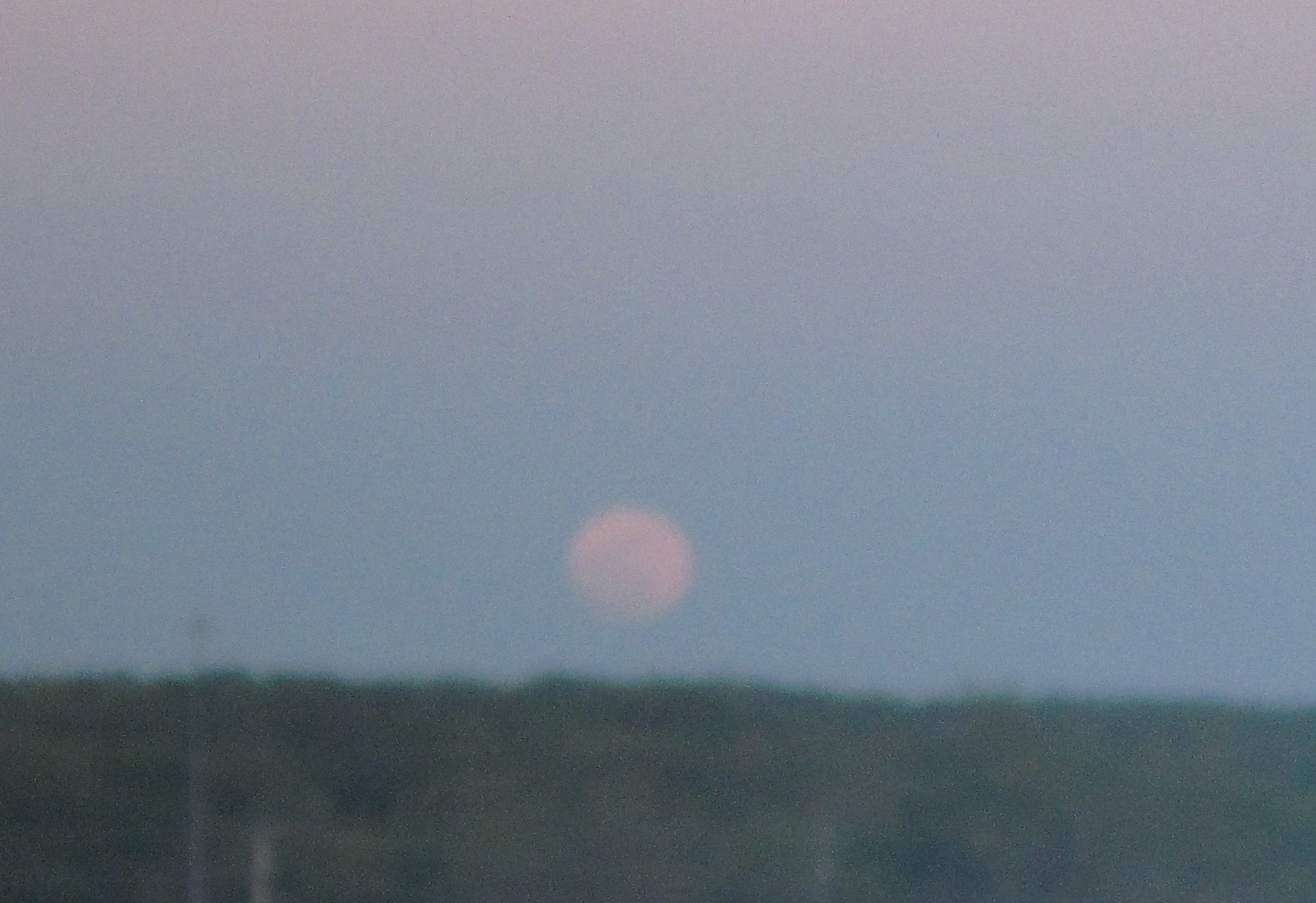
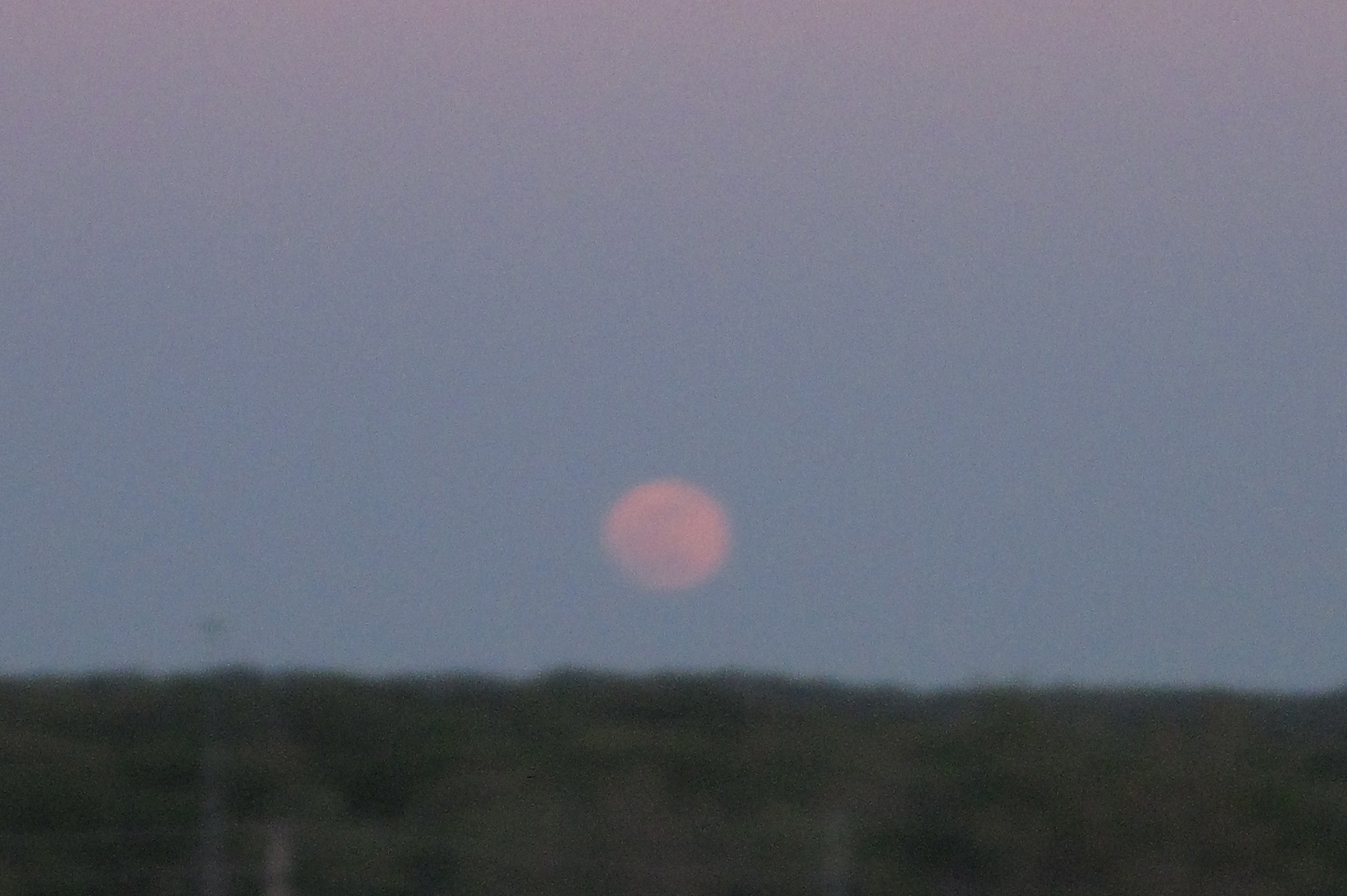
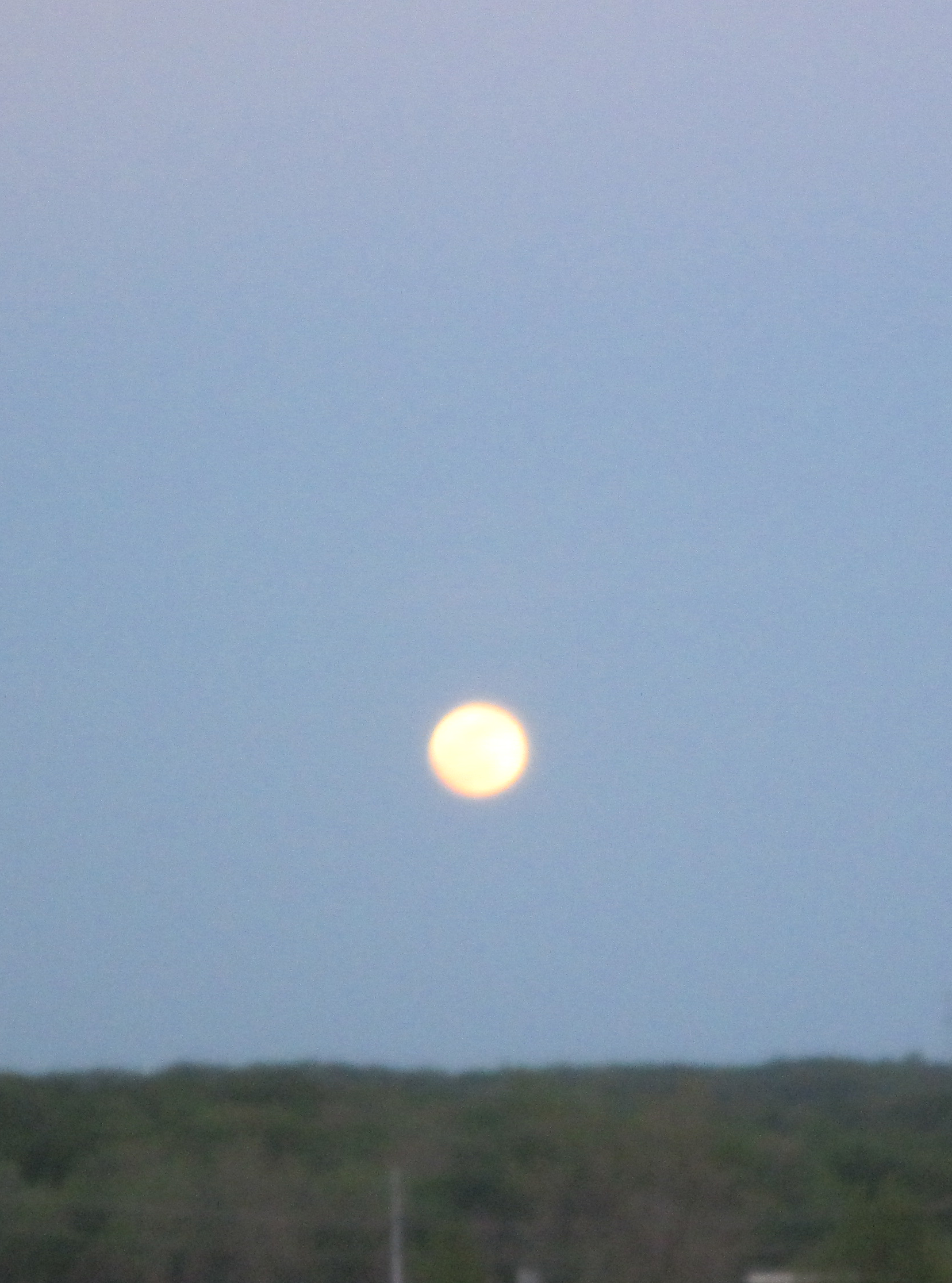
I drove to a high spot with an unobstructed view and gazed toward what was (I hoped) east.  And  soon a ghostly white and very large full moon rose up from the horizon.  I was surprised at how fast the moon rose – actually a function of how fast the earth is spinning.  It was pretty impressive.  I was not as impressed by my photos of the event, so I found the one above which is better.

I actually went outside later that night (3:00 am) and the moon was so bright that it made the trees cast very distinct shadows on the ground.

I read that the tides are higher at these times, as well, but living on Lake Erie with a tidal range of inches, it did not make much difference.

Here are the figures: the distance between the Moon and the Earth varies from around 356,400 km (at perigee) to 406,700 km (at apogee.)

My photos:

h1

What am I looking into?

April 12, 2012

Pointing at a seemingly empty area of the sky, the Hubble Space Telescope revealed a surprise in deep space. Thanks, C, for this cool video.

h1

What burner am I celebrating today?

March 31, 2012

March 31 is Bunsen Burner Day – commemorating the birth in 1811 of German chemist Robert Wilhelm Eberhard von Bunsen, the inventor (refiner) of the laboratory device that bears his name.

I relate the tale of when I was in college chemistry lab.  We were doing something with hydrochloric acid that involved heating it in a test tube over a – you guessed it – Bunsen burner.  I was working next to a nice fellow whose name I do not remember.  I do remember that the acid in my test tube kept boiling and shooting out of the test tube, showering my lab neighbor with a fine spray of hot hydrochloric acid.  I do remember him saying, “Oh, Oo, Ow.” I do remember apologizing over and over.  I do remember him being very gracious.  I also remember seeing a number of small holes begin to appear in his clothing.  I did not point that out to him.  Anyway, lab neighbor from the past, I am still sorry and hope you have suffered no lasting consequences.

So a salute to Robert Wilhelm Eberhard von Bunsen, who made this laboratory escapade possible.

Flame on!

h1

What day did I miss mentioning?

March 21, 2012

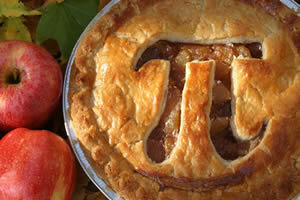
Blast! March 14 was Pi Day and I missed it!  Granted, I was busy pillaging that day, but, no excuse.

This is not to be confused with National Pie Day, which is January 23, or whenever I choose to put it on the calendar.

Pi Day, however, is defined by the Pi Day website as:

Pi, Greek letter (π), is the symbol for the ratio of the circumference of a circle to its diameter. Pi Day is celebrated by math enthusiasts around the world on March 14th. Pi = 3.1415926535…

With the use of computers, Pi has been calculated to over 1 trillion digits past the decimal. Pi is an irrational and transcendental number meaning it will continue infinitely without repeating. The symbol for pi was first used in 1706 by William Jones, but was popular after it was adopted by the Swiss mathematician Leonhard Euler in 1737.

Pi is an irrational number and there is no getting a-round it.  Sorry.