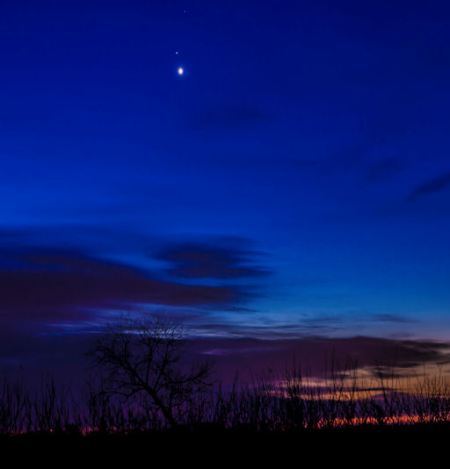
Besides the obvious benefits of a 7:00 am yoga class sometimes I get to see something like this, as I did last Wednesday. This is Venus in the early morning sky.
And on my way home from work that evening, I saw the new moon in the old moon’s arms. It’s a little hazy, but was still quite lovely. The light below the moon is a Lifeflight helicopter heading for the Cleveland Clinic.
Suomi NPP satellite image of North and South America at night
In daylight our big blue marble is all land, oceans and clouds. But the night is electric.
This image of North and South America at night is a composite assembled from data acquired by the Suomi NPP satellite in April and October 2012. The new data was mapped over existing Blue Marble imagery of Earth to provide a realistic view of the planet.
The nighttime view was made possible by the new satellite’s “day-night band” of the Visible Infrared Imaging Radiometer Suite. VIIRS detects light in a range of wavelengths from green to near-infrared and uses filtering techniques to observe dim signals such as city lights, gas flares, auroras, wildfires, and reflected moonlight. In this case, auroras, fires, and other stray light have been removed to emphasize the city lights.
Although the view looking down from space is of a sparkling show, the downside of course is light pollution over major metropolitan areas which impede the view of the night sky from the ground. (Find out more at the International Dark Sky Association site.)
Read more (and watch a video of these nighttime images of Earth) below:
“Artificial lighting is a excellent remote sensing observable and proxy for human activity,” says Chris Elvidge, who leads the Earth Observation Group at NOAA’s National Geophysical Data Center. Social scientists and demographers have used night lights to model the spatial distribution of economic activity, of constructed surfaces, and of populations. Planners and environmental groups have used maps of lights to select sites for astronomical observatories and to monitor human development around parks and wildlife refuges. Electric power companies, emergency managers, and news media turn to night lights to observe blackouts.
This video uses the Earth at night view created by NASA’s Earth Observatory with data processed by NOAA’s National Geophysical Data Center and combined with a version of the Earth Observatory’s Blue Marble: Next Generation.
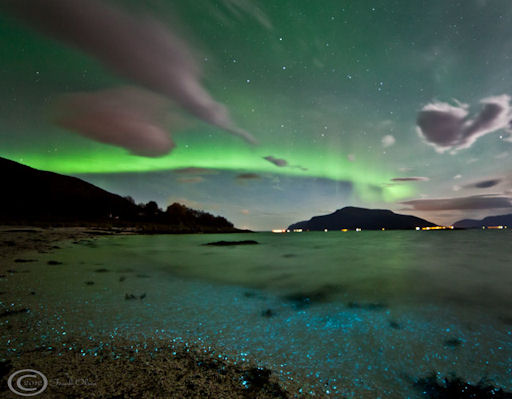
I thought this was a marvelous photograph. It was taken by Frank Olsen in Sortland, Norway. Reference is SpaceWeather.com. The photographer captured an impressive multitude of glowing things in this photo – the stars overhead, the green auroras, and the sparkling, luminescent dinoflagellates on the beach.
I’m a little slow on the uptake, but September 22 was International Observe the Moon Day. Thanks to Lights in the Dark for recommending this amazing video. I’ve got my bags all packed for the next shuttle . . . oh, never mind.
Qixi – the Milky Way Festival or the Night of Sevens.
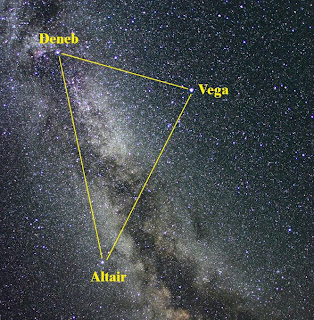
This is the story of star-crossed lovers, Zhinu an imortal member of the Queen of Heaven’s family, and Niulang, a lowly cowherd. Zhinu is represented in the sky by the star Vega; Niulang is represented by Altair. Both of these stars are prominent in the summer night sky as two points in the asterism known as the Summer Triangle.
There are, of course, many versions and variations on the story, but just as in Romeo and Juliet, the two main characters meet and fall in love. In this instance they marry, have two children and think that they are home free on their way to happily every after.
But the Queen of Heaven, who up to now has not been paying attention, finds out about the liaison and demands that Zhinu return to the sky where she must again take up her regular job of weaving colorful clouds. This is a job which, apparently, no one else can do.
Niulang is despondent – he is also left with two little kids to raise by himself. Now things get a little strange. His ox begins to talk to him. Listening to the ox’s advice, Niulang kills the beast, puts on its skin, picks up the kids and travels to heaven to reclaim his wife.
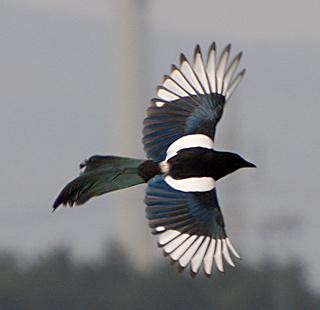
He was not fast enough, however, because Queenie learns of the plan and scratches a huge river across the sky between Zhinu and Niulang creating the Milky Way – a river they cannot cross – EXCEPT on the seventh night of the seventh month when the magpies fly up to heaven and create a sky bridge so that the lovers can be together on that one night of the year.
This Chinese festival is related to the Japanese Star Festival, Tanabata.
We often talk about the Dog Days of Summer, but August 17 marks the beginning of Cat Nights, which come with wonderful stories about witches and their cunning ways.
The Farmer’s Almanac describes Cat Nights:
The term “Cat Nights” harks back to a rather obscure old Irish legend concerning witches and the belief that a witch could turn herself into a cat eight times, but on the ninth time (August 17), she couldn’t regain her human form. This bit of folklore also gives us the saying, “A cat has nine lives.” Because August is a yowly time for cats, this may have prompted the speculation about witches on the prowl in the first place.
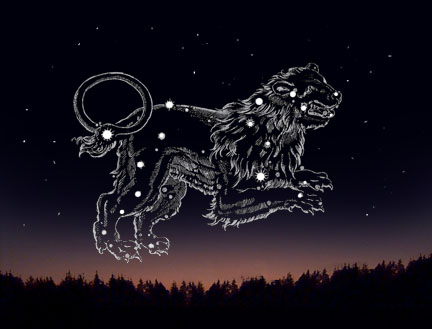
In addition, there are a number of feline constellations in the night sky at this time – Leo Major, Leo Minor and the Lynx all appear. More here at space.com.
I came across this video in a reference on Why. Because Science. And it features my favorite astrophysicist. It also features Larry Krause and Richard Feynman.
I remember hearing this concept for the first time (for me) from Carl (Billions and Billions) Sagan on Cosmos.














 Gunsmoke and Knitting