
Posts Tagged ‘Friday’

What am I sappy Kiwi blogging?
September 1, 2017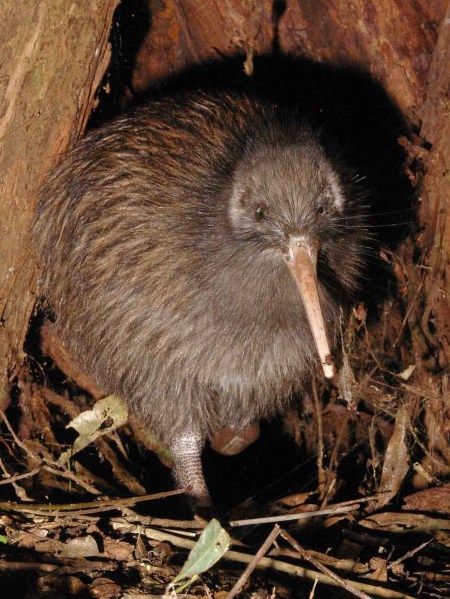
Image credits: Maungatautari Ecological Island Trust.
“Kiwi are only found in New Zealand and are part of the group of ratites, which includes ostriches and emus, and are actually the smallest members of the group. For comparison, they are about the same size as a chicken. Though it was expected that the kiwi would be more closely related the moa (extinct), which also lived in New Zealand, they actually are much more closely related to the elephant birds of Madagascar (also extinct). It is hypothesized that the kiwi’s ancestor was able to fly and reached New Zealand separately from moas. Once on the island, it lost its ability to fly and eventually became the kiwi bird known today. Actually, the Latin genus name of kiwi birds, Apteryx, is based on their inability to fly. The “a-” means “without” and “pterux” means “wing”. They do have very tiny, vestigial wings, but you can barely see them and they aren’t any help with levitation.”
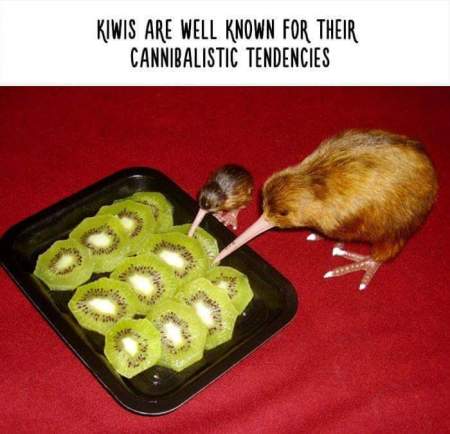
Kiwi have feathers that look like hair and very strong, muscular legs. They rule the ground instead of the air. They can smell very well and are the only bird that have nostrils at the end of their beaks, which are quite long. They use their nostrils to sniff out invertebrates and seeds to eat. They can use just smell to detect food.
Kiwi birds are quite shy and usually only come out at night. Kiwi can live a long time, between 25 and 50 years. Once a male and female bond they spend their whole lives as a monogamous couple. During the mating season, they call to each other at night, and meet each other about every three days in the nesting burrow. Kiwi live in forests, scrublands, and grasslands. They sleep in burrows, hollow logs, or in the middle of dense vegetation. They are very territorial and defend their territory against other kiwi. Another weird fact is that, according to the San Diego Zoo, kiwi have the lowest body temperature of any bird, 38 °C (100 Fahrenheit).

The size of an egg inside of a kiwi. Image credits: Matt Chan.
The females carry huge eggs for their body size. A female can carry an egg up to one-quarter of their body weight. As mentioned before, the kiwi is about the same size as a chicken but its egg is actually six times as large as a chicken’s egg. The reason for this is that the kiwi bird doesn’t have to fly so there aren’t any constraints on its weight. It doesn’t need to be aerodynamic. Kiwi also has marrow in their bones, like humans, which also makes them heavier. The female has to eat three times as much as usual to help the egg develop. Right before the egg is laid she can’t eat anything because the egg presses against her stomach, leaving no room for food. Tthe chicks hatch pretty much developed; they have feathers already and fend for themselves right from the get-go. However, they take between three and five years to grow to their full size.”
Reblogged from Animal Files at ZME Science.

What am I sappy water bear blogging?
August 4, 2017
credit: SciSource
When I was studying biology, we knew them as water bears, however . . “the tiny tardigrade has been named the world’s most indestructible species after scientists discovered it is the only creature that will survive until the Sun dies.
Although cockroaches are traditionally seen as Earth’s most resilient species, the eight-legged microbeasts are actually far hardier and will continue to thrive for around 10 billion years, come hell or high water, Oxford University has found.
Tardigrades, which are also known as space bears or moss piglets, are able to survive for up to 30 years without food or water and endure temperature extremes of up to 150 degrees celsius, the deep sea and the frozen vacuum of space.
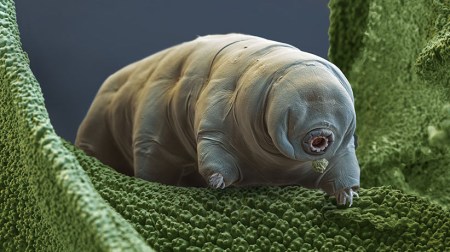
credit: SciSource
Researchers from Oxford and Harvard University, found that their astonishing abilities would protect them from calamities which would wipe out all life on Earth. In fact the only forces capable of harming tardigrades, such as a gigantic asteroid, an exploding star or a deadly gammar ray burst will not happen before our own Sun dies.
Not only does it suggest that tardigrades will survive long after humans have died out, but it gives hope that life could exist on even the most barren and hostile planets.
“Life on this planet can continue long after humans are gone,” said Dr Rafael Alves Batista, of the Department of Physics at Oxford University.
“Tardigrades are as close to indestructible as it gets on Earth, but it is possible that there are other resilient species examples elsewhere in the universe.
“In this context there is a real case for looking for life on Mars and in other areas of the solar system in general. If Tardigrades are earth’s most resilient species, who knows what else is out there.”
What am I sappy dog blogging?
July 28, 2017
Putting on the dog – a canine who knows the secret menu at In-N-Out.
What am I sappy cat blogging?
July 21, 2017
“Priest Solodkov, the ship’s doctor and the ship’s cat on the deck of Kagul, Bizerta, 1921. Kagul (renamed Ochakov, later General Kornilov) was built by Sevastopol dockyard. Laid down 1900, launched October 1902, completed 1905, seized by the White forces in the Russian Civil War and interned in Bizerta in 1920 as part of Wrangel’s fleet, sold for scrap in 1933.
What am I sappy cat blogging?
July 14, 2017Do Cats Purr When Humans are not Around?
Why do cats purr? Humans tend to think that purring is a sign of happiness in a cat – and indeed it can be – but there are other reasons why our feline friends produce this particular vocalisation.
Purring is a habit that develops very early in a cat’s life, while suckling from its mother, so clearly it is not a sound that is directed solely at humans.
Cat owners will be well aware that a cat can produce more than one kind of purr, just as they have a whole repertoire of meows, chirps, growls, spits and other sounds.
The purr that is produced during suckling, is quite different in quality to the purr that you will hear when your cat is sprawling across your lap being stroked.
Analysis of the sound has shown when a cat is asking for food, whether from its mother or a human – the purr contains a high-pitched note that is similar in frequency to a cry (though not as loud). It may have something of the effect of the cry of a newborn, which affects the hormonal state of female mammals and elicits a care-giving response.
When a cat is being petted or is snuggled up to its owner on the sofa, the purr it produces is much more soporific and generally soothing, and acoustic analysis shows that the “cry” component is missing.
Adult cats will often purr when they are close to or in physical contact with another cat, engaging in grooming for example. They will also do it when they play with an inanimate object, or while eating, which can be at a time when they are alone.
However, the most usual time for purring is in company, and it can be the care soliciting sound, asking to be fed or stroked, or an indication of social pleasure.
The darker side
Strangely, vets also report that cats will purr when they are in great pain or just before death. This seems to be illogical if it is a sound relating to pleasure, but in fact, it could be that the cat is asking for help.
It could also be a way of masking the fact that the cat is injured and vulnerable. If you are a small animal, even a carnivore, it is not good to show weakness as this could encourage larger predators to come along and eat you.
The purr may be the cat equivalent of “everything’s fine, I’m on top of the world. Nothing to see here, move along please”.
Can big cats purr too?
There has long been a debate about whether the “big cats” can purr – and the belief has been that cats that roar, such as lions and tigers, cannot purr. Although there is no conclusive evidence on this subject, it seems that even cats that roar purr as cubs while suckling.
All mammals have a bone or series of bones in the throat called the hyoid apparatus, which supports the larynx and tongue. In cat species that roar the hyoid apparatus is not entirely made of bone but retains some parts as cartilage, while cat species that purr have a hyoid that is completely bony.
This modification may permit roaring, but does not necessarily mean that purring is impossible. It is believed that cheetah, ocelot, margay, serval, and lynx, among other species, can purr, and it is suggested that jaguar, leopard, lion and tiger cannot – or if they can they’ve kept it secret all these years.
Process behind the purr
The actual process of producing the purring sound is complicated, and is still not completely understood, but it involves the muscles of the larynx and the diaphragm being activated by bursts of nerve activity that originate in the brain and occur 20 to 30 times every second.
This happens on both in and out breaths, which accounts for the continuous sound of the purr.
The fact that a cat can do all this and simultaneously eat, knead the cushions, rip the chair leg to pieces or weave complicated patterns through your legs without getting stepped on makes one wonder what they would have achieved with opposable thumbs.
What am I sappy pet blogging?
July 7, 2017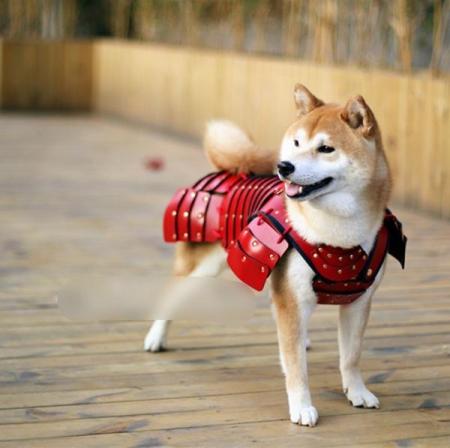
A suited-up Shiba Inu in custom-made armor | all photos courtesy of SAMURAI AGE
While it’s been over 150 years since the heyday of the samurai class, the fascination with them lives on. The talented craftsmen at SAMURAI AGE are doing their part to honor samurai tradition with handmade, high-quality samurai armor for you and your pets.
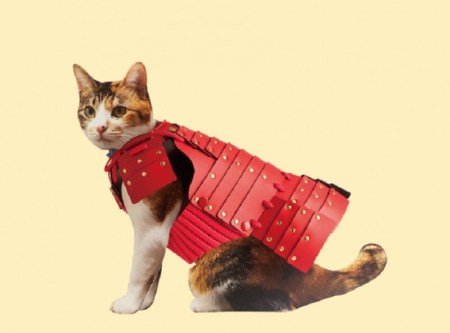
The handmade armor is made with polystyrene, polyurethane, metal fastenings, fusahimo cord, and metal snaps.
One of the selling points of this Fukuoka-based brand’s armor is how lightweight it is. Unlike traditional samurai armor, which could sometimes weigh over 60 pounds, SAMURAI AGE’s pet armor is constructed from light plastic that they claim can be worn for long stretches of time without tiring out its wearer. So although your pet will probably not be protected from any katana strikes, they will at the very least feel both badass and comfortable.
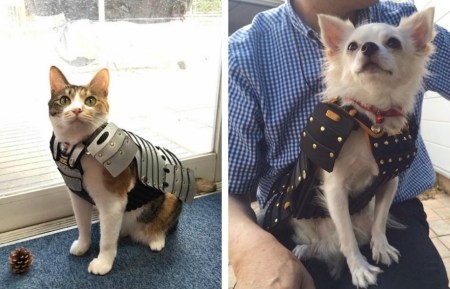
Also available in black, silver, and gold.
When not in use by your dog or cat, the armor can be repurposed in other creative ways.
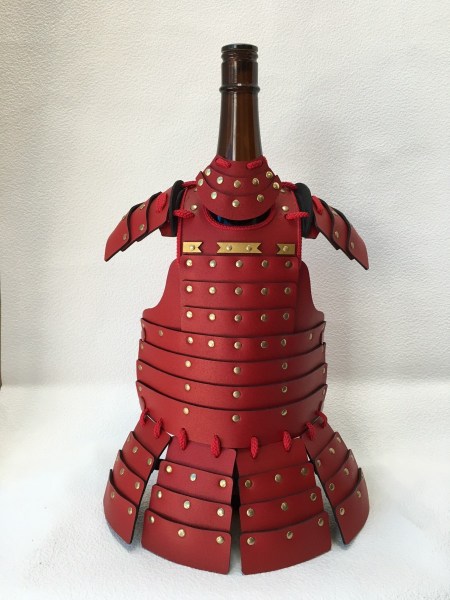
As a bottle cover for a large bottle of sake…
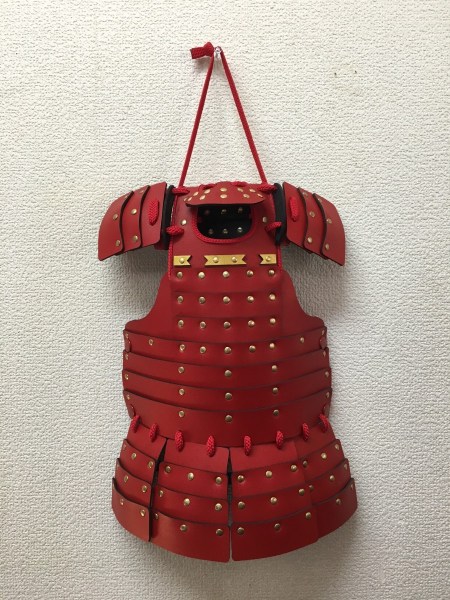
…or hung up on your wall for decoration.
Human-sized armor for adults and children is also available for purchase, as well as helmets and bottle covers. All items are made of the same materials as the pet armor. The website suggests wearing the armor for birthdays or special occasions, but given the stylish, lightweight material there’s no reason not to wear it on a regular basis, too.
For those interested in a more “casual” look, SAMURAI AGE offers samurai helmets fashioned from polyester baseball caps. Customers can choose helmet designs based on those worn by famous Japanese historical figures such as Tokugawa Ieyasu, Oda Nobunaga, and Toyotomi Hideyoshi.
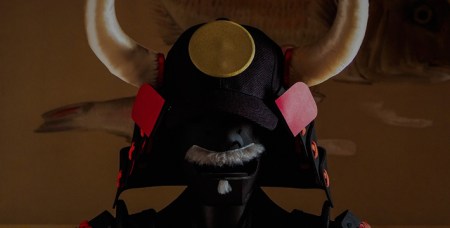
A cap based on Fukuoka daimyo Kuroda Nagamasa’s helmet. Mustache included.










 Gunsmoke and Knitting